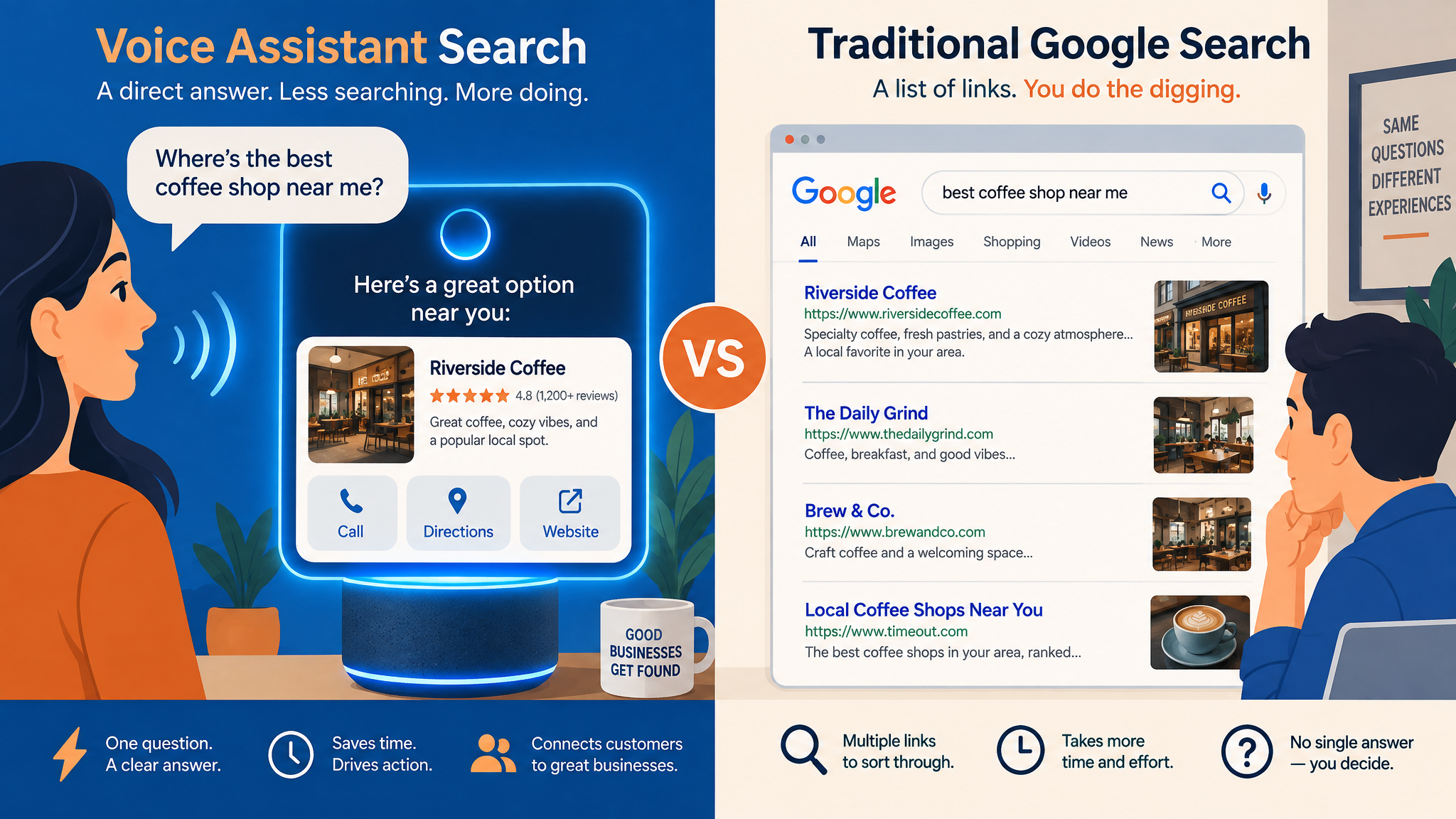
Generative Engine Optimization (GEO) is the practice of structuring your content and online presence so that AI powered search engines, like Google AI Overviews, Perplexity, and Bing Copilot, cite and recommend your business inside their generated answers. Where SEO aims to rank a page, GEO aims to make your business the trusted source the AI quotes. For small businesses, that means clear answers, consistent facts, and strong trust signals.
What does GEO actually mean?
When you ask an AI search engine a question, it does not just hand you ten links. It writes an answer and, increasingly, names specific sources and businesses. GEO is the work of making sure your business is one of those named sources. It is less about chasing a top ranking and more about being the clearest, most trustworthy answer to a specific question.
Think of it this way: SEO helps you get into the library. GEO helps you become the book the librarian actually recommends.
How is GEO different from SEO?
They share a foundation, but the goals differ. SEO optimizes for search rankings. GEO optimizes for being quoted and recommended inside AI answers. You need both, and the good news is that doing one well usually helps the other.
| Question | SEO | GEO |
|---|---|---|
| What is the target? | A high ranking link | A citation inside the AI answer |
| What wins? | Authority and keywords | Clarity, facts, and trust signals |
| Best content format | In depth pages | Direct answers and structured data |
| Who sees it first? | People who scroll results | People who read the AI summary |
Why GEO matters for small businesses now
A large and growing share of searches now end with an AI answer at the top of the page. Many people never scroll past it. If the AI names three businesses and you are not one of them, you lost that customer before they ever saw your website. Small local businesses actually have an advantage here, because AI answers to specific, local questions have far less competition than broad national terms.
How to start optimizing for generative engines
- Answer one clear question per page, near the top, in two or three sentences.
- Keep your business facts (name, location, services, pricing style) consistent everywhere.
- Add FAQ and structured data so AI can extract your answers cleanly.
- Build genuine reviews and third party mentions to earn trust.
- Write in plain language a person, and a machine, can quote directly.
How long does GEO take to work?
Most businesses see movement within two to six months as AI engines refresh their sources. It is not instant, but it compounds. Once you are established as a trusted answer to a question, you tend to keep appearing, which is far more durable than paying for every click.
About the author
Yaffa Doushy
Co-Founder, SoulSisters Digital Marketing
Yaffa Doushy is a co-founder of SoulSisters Digital Marketing. She focuses on AI search optimization, content, and helping small businesses show up in tools like ChatGPT, Perplexity, and Google AI Overviews. She is passionate about making powerful marketing accessible to businesses of every size.